
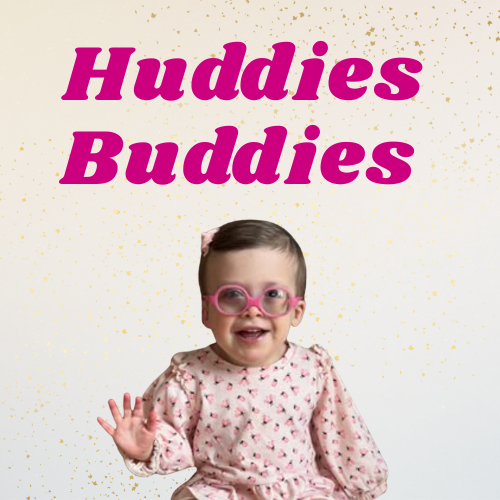
Welcome to Huddies Buddies.
We're so glad you're here!!
Ways to Donate & Support:
University of Rochester Occular Genetics Direct Donation Link:
*Instructions:
-
Under Gift Designation Selection choose Gene Discovery & Treatment
-
Comment box write: Occular Genetics
-
In Honor of: Hudson Moore or The family of Hudson Moore
-
Please fill out your name & complete mailing address in the box below
Huddies Buddies Co Etsy:
Follow our Journey with Rare Disease


Hudson’s Story
Year 1
On March 21, 2024, our beautiful baby girl entered the world at just 34 weeks, weighing 4 pounds 6 ounces. During her detailed birth exam, one of the NICU doctors noticed something beautiful about her eyes — she was born without irises, the part of the eye that gives your eye color.
That moment set off a whirlwind of genetic testing and ultrasounds in the very first days of her life. We spent an anxious month waiting for answers, trying to prepare ourselves for the unknown. But even in that uncertainty, we knew one thing for sure: our girl was perfect.
From the very beginning, she was strong, she was sassy, and she carried a light that everyone around her could feel. At just days old, she had the most radiant energy — one that reminded us that even in the midst of fear, joy can still find its way in.
When the most detailed microarray genetic panel returned, we finally had clarity. We learned Hudson was 1 in a million. She is one of approximately 500 people in the world diagnosed with WAGR syndrome, a rare genetic condition characterized by the deletion of parts of chromosome 11, specifically in the 11p13 region. Most individuals with WAGR are missing that genetic material entirely. But in true Hudson fashion, her genetics don’t follow the typical pattern.

Instead of a full deletion, Hudson also has a chromosome inversion — meaning the genetic information is present, but flipped in orientation. It’s not yet known how this inversion may shape her long-term journey, but her medical team feels encouraged. Having the genetic material present at all, even inverted, may be one reason she continues to meet so many developmental milestones.
Hudson feeds herself (usually something involving peanut butter), is learning to talk and communicate what she wants — “up,” “down,” “open,” and a very dramatic “no no no,” complete with a finger wag — toddlers everywhere with purpose, and insists on putting tops back on water bottles and pouches with surprising focus and determination.
As most of you know, everything changed shortly after her month-long NICU stay. During that month of waiting for her to grow, my family and I dove into researching WAGR, aniridia, and the best specialists in the world for each part of the condition she might face. At that time, her eyes were our biggest fear — Was she blind? Could she see us? Could we take her outside without causing her pain?

You best believe that I emailed (and, if we’re being honest, basically stalked) one of the world’s leading ophthalmologists for aniridia. Two days after Hudson was discharged from the NICU, we packed up our newborn baby and drove eight hours to meet Dr. Alex Levin at the University of Rochester’s Flaum Eye Institute.
From the moment he walked into the room and offered to change her stinky diaper, he made us feel as though we had known him forever. He spoke to us not just as a physician but as a partner in Hudson’s care — someone who understood the fear, the uncertainty, and the weight of a life-changing diagnosis. He gave us the confidence we desperately needed as young parents navigating the new, overwhelming WAGR world.
At that first appointment, Hudson’s eyes were deemed clear of any serious issues. For a moment, we could breathe.
But just a few weeks later, Dr. Levin received a call from a very anxious mom saying, “One of her eyes is starting to look foggy.” Two days later, Hudson was at UR Strong Surgery Center undergoing her first eye exam under anesthesia (EUA), where she received her first diagnosis of glaucoma.
Hudson’s right eye continued to decline, eventually developing a cataract that required a lens removal surgery and ultimately left us with no option other than a corneal transplant at just seven months old.
Mitch and I knew we could not get through this incredibly difficult eye journey without Dr. Levin as her primary ophthalmologist. We remained with the UR Flaum Eye Institute, where we then met Dr. Esteban Santiago, Hudson’s corneal transplant surgeon. This marked an exciting, terrifying, exhausting, and deeply emotional chapter of our lives — a winter spent almost entirely in Rochester, doing everything possible to help her transplant thrive.
What we didn’t know was that we would gain another family along the way. Within the University of Rochester’s Surgical Center, Hudson underwent over 28 procedures and exams before her 18-month birthday, and in that time we found a group of “aunties” (and an “uncle”) who loved her, protected her, and celebrated every tiny victory with us. They have become a family we could never do this journey without.
Unfortunately, because WAGR causes a lack of healthy limbal stem cells, the very cells needed to support long-term transplant success, we always knew the odds were slim. Still, Hudson experienced five incredible months of bilateral vision, months where she grew, explored, and developed in remarkable ways.

But on her first birthday, she became sick with the flu and strep throat. The infections attacked her transplant, slowly causing it to become cloudy again. Today, she has no usable vision in her right eye. We remain hopeful she may see shapes or light through it, but we simply don’t know.
We continue to monitor both of her eyes extremely closely — locally in Waterbury with Dr. Debenedictis, who trained under Dr. Levin, and with Dr. Levin himself. Right now, her glaucoma is stable in both eyes, and all we can do is pray it remains stable long enough for RESEARCH to give her “good left eye” the chance to stay healthy and avoid the many challenges of a degenerative eye disease.


Year 1 - Present
As many of you already know, the “W” in WAGR stands for Wilms tumor, a form of kidney cancer. Due to the deletion of the WT1 gene on chromosome 11, more than half of children with WAGR will develop Wilms tumor before age eight. Because of this, it is standard protocol for our WAGR babies to have kidney ultrasounds every three months.
What is terrifying about Wilms tumor is that a child can have a completely clear scan and then just three months later have a tennis-ball-sized tumor.
Hudson had her first kidney ultrasound while still in the NICU and continued every three months without fail — until we saw spots that appeared suspicious. With the help of another incredible physician, Dr. Daniel Weiser, we began watching these lesions more closely. Ultrasounds became every six weeks, and MRIs every six weeks after that for more detailed imaging.
After months of monitoring, some spots remained stable and never grew, while others grew slowly — which is not typical of Wilms tumor.

This waiting game was unbearable — the anxiety leading up to every scan, holding your breath for every report, and then waiting an additional week for tumor board meetings to understand what was happening. After one MRI, we saw significant changes in the characteristics of the main lesion we had been watching, and ultimately Hudson began treatment.
So here we are — our beautiful Hudson battling kidney cancer at just 19 months old.

While Wilms tumors are not extraordinarily rare in pediatrics, genetic Wilms tumors like Hudson’s — those directly caused by the WT1 gene deletion — are extremely rare.
After deciding that Hudson’s treatment would continue at Memorial Sloan Kettering, everything moved quickly. Within 24 hours of meeting Dr. Ortiz and his nurse practitioner Talia, Hudson was in surgery to have her port placed for chemotherapy — and she began chemo that very same day. It was one of the most intense, overwhelming days of our lives.
Dr. Ortiz and Talia truly are the superheroes of oncology.
Which brings us to today — November 16, 2025 — and a very full week ahead.
Tomorrow, Hudson has her final chemo before her surgery on Thursday. Due to the nature of WAGR and the complexity of the WT1 kidney, this surgery is performed only about 35 times a year in the entire country. She will spend a few nights in the Pediatric ICU, and we are hopeful for a 5–7 day stay. She may need to come home with drains. The pathology of the tumor will determine her next steps and whether further treatment will be needed.
So now that I have summarized the past 19 months of our lives, this brings us to the next chapter:
FUNDRAISING & RESEARCH
Although this phase of life is chaotic, emotionally draining, and physically exhausting for our family, sitting back and watching this disease take moments away from Hudson and from so many other WAGR families simply isn’t an option.
Every morning, when I look into Hudson’s eyes — one beautifully black, the other now completely clouded — I find myself thinking, “What if today is the last day she can see me? See my smile? See my face light up when she gives me a kiss or does something adorable?”
It breaks my heart in ways I can’t put into words.

Mitch constantly tells me, “Every day our girl can see is a good day.” And he’s right. But we also know that with meaningful research, the idea of her losing her remaining sight does not have to be her future.
The reality of WAGR is that it doesn’t get easier with age. Aniridia is degenerative, and as it stands, Hudson has meaningful vision only in her left eye and is extremely nearsighted.
Kidney disease becomes more common as WAGR children grow, and Hudson already battles hypertension. These are just a few of the challenges ahead.
We refuse to sit here and watch this disease cause our sweet girl to miss out on any more of her life. We need ongoing, consistent, and well-funded research to develop medical advances that could change Hudson’s life — and the lives of all her WAGR buddies.
FUNDRAISING & SUPPORT
Direct Donation to University of Rochester, Flaum Eye Institute OCCULAR GENETICS RESEARCH:
* Donation Instructions:
-
Under Gift Designation Selection choose Gene Discovery & Treatment
-
Comment box write: Occular Genetics
-
In Honor of: Hudson Moore or The family of Hudson Moore
-
Please fill out your name & complete mailing address in the box below
We spent months going back and forth on where we wanted to focus funding for our first-ever fundraiser for Hudson, WAGR, and rare disease. From our story, I believe it’s clear that ocular genetics plays a tremendous role in aniridia and therefore in WAGR syndrome. From firsthand experience, we know how devastating it is to watch a loved one lose vision — and to live with the fear that they may become fully blind.
There are so many promising advancements happening right now in ocular genetics, including gene therapy, gene editing, drug repurposing, stem-cell therapies, and even a bionic eye known as the Gennaris Bionic Vision System. Every single day, I beg the universe for one of these breakthroughs to arrive before the stong possibility Hudson “good eye” declines — or, if not before, then at least during her lifetime, to restore vision in some capacity. This is where that hope begins.
Hope begins with research.
Dr. Levin — who we now lovingly call Hudson’s “honorary grandparent” — dedicates his life to rare eye disease. He travels the world for conferences, advances his education, and continually studies emerging treatments. He teaches the next generation of ophthalmologists globally. We know the University of Rochester is constantly utilizing the newest and most innovative technologies to help the visually impaired community.
Working closely with the University of Rochester, we now have a DIRECT DONATION LINK to the ocular genetics department. This ensures that every single penny raised goes directly to their ongoing research. Making sure that funds are not diverted to other areas was extremely important to us.
HUDDIES BUDDIES CO. : my newfound passion project and Etsy store!
My hope for Huddies Buddies Co isn’t just to fundraise for Hudson and all of her upcoming challenges with WAGR. It is also to create more awareness, acceptance, hope, positivity, and community around rare disease. Our zebra babies — and we parents — deserve to feel proud of our rare journeys. Too often, it is isolating and makes you feel like you’re walking this path alone.
Imagine having just been told your daughter or son had WAGR syndrome. You look for hope and community in all places but can’t seem to find anyone who understands your new life. While waiting in line for coffee you see a woman wearing a sweatshirt that says “Rare Disease Mom” loud and proud. Not only do you suddenly feel less alone, but you may even have found a new friend.
As an Emergency Department nurse, I learned that sometimes all someone needs is to feel seen, to feel heard, and to feel like they aren’t alone in whatever they are battling. My goal is for Huddies Buddies Co apparel and gifts to be worn with pride, reminding people that RARE IS BEAUTIFUL. There are so many incredible people navigating rare diseases themselves or alongside a loved one, yet rare disease is rarely celebrated. Medical moms are rarely celebrated. Huddies Buddies Co changes that.
I share updates regularly — both medical and day-to-day life — as we navigate Hudson’s journey. Alongside that, I’ve been diligently working on building a community and support space for moms navigating rare disease, disability, chronic illness, and the many layers that come with holding the title of “medical mom” or “medical mama.”
During the first few months of Hudson’s life, I searched every corner of social media trying to find someone whose life looked like mine — a terrified new mom in the NICU with a newborn and an unexpected diagnosis. As a postpartum mother, I didn’t know who to turn to emotionally with all of these feelings. I was celebrating having a new baby while simultaneously mourning the life I thought we would have.
The community I’ve already become a part of — and continue to build — has become a place I turn to when I feel lonely, when I’m mourning the life I imagined, and most importantly, when I need connection with moms who truly understand. No one understands the daily realities of medical motherhood more than another medical mom — those living it alongside you or who have lived it themselves.
If you know someone struggling after receiving a diagnosis — whether for themselves or their child — please send them my way. I would love to support them. I’m an open book (as you can probably tell)!


